

- IDENTITY, MISSION AND KEY VALUES
- BASELINE ASSESSMENT
- PRIORITY STRATEGIC OBJECTIVES
- KEY COMPETENCES AND MAIN TARGET APPLICATIONS OF RESEARCH
- LINK TO OTHER DOCUMENTS
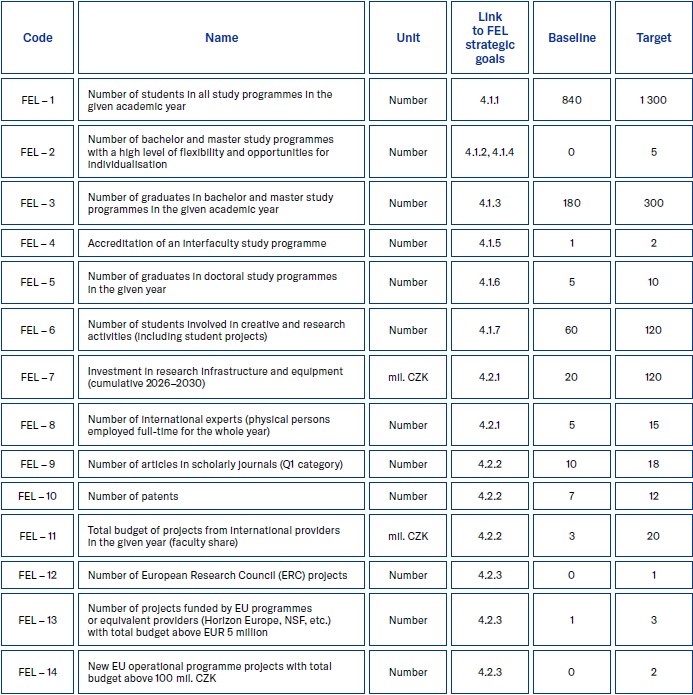
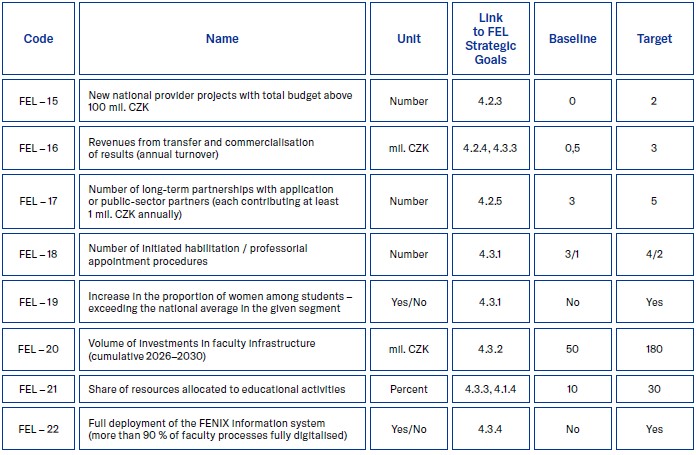
- STRATEGIC INDICATORS
IDENTITY, MISSION AND KEY VALUES
FACULTY IDENTITY
The Faculty of Electrical Engineering (FEL) of the University of West Bohemia (UWB) is an open research-education institution providing comprehensive education in doctoral, master’s follow-up, and bachelor’s study programmes. In its key disciplines, it ranks among the most significant European institutions, with strong links to industry. Its graduates have an excellent starting position in the labour market, are consistently sought after by employers, or successfully pursue entrepreneurial careers. The faculty conducts both fundamental and extensive applied research with significant real-world impact and contributes to societal development at the national and international levels.
FACULTY MISSION
- To support open and equal access to education and to the freedom of scientific inquiry.
- To deliver study programmes, including lifelong learning, that respond to society’s evolving needs and incorporate the latest global knowledge using innovative teaching methods.
- To prepare graduates for successful entrepreneurial activities or for strong employability in the labour market and in society.
- To contribute to the creation, dissemination, and adoption of new knowledge in areas where the faculty possesses key competencies, and to support scientific and technological innovation leading to applications in everyday life.
- To contribute to closer integration of the faculty and the university with regional, national, European, and global communities.
KEY VALUES
The Faculty upholds the following key values:
- Freedom, democracy, and ethics.
- Courage and responsibility.
- Openness.
- Individual and equal treatment; fairness.
- Professionalism and expertise.
MAIN AREAS OF EXPERTISE
The core educational, creative, and research activities of the faculty focus on the following areas:
- Electrical engineering
- Computer engineering
- Material engineering
- Power engineering
- Transportation engineering
ASSESSMENT OF THE INITIAL SITUATION
The faculty has long ranked among the top three faculties of electrical engineering in the Czech Republic. Its focus includes not only electrical engineering, computer engineering, and materials engineering, but also features significant interdisciplinary overlaps, particularly in transportation, energy, robotics, the textile industry, agriculture, production and industrial technologies, space technologies, physics, and chemistry. The faculty’s historical achievements and extensive cooperation with industry and the public sector attest to why it is regarded
as a research faculty.
We consider high-quality, internationally respected research to be a necessary condition for ensuring the high standard of the faculty’s educational activities. It is essential for the faculty not only to provide high-quality education at the bachelor’s and master’s levels, but also to offer a prestigious doctoral education that is closely linked to the faculty’s key research programmes. The faculty provides its students with the opportunity to obtain a comprehensive education — that is, to become experts not only in the faculty’s main fields of activity listed above, but also to gain essential legal, economic, and managerial knowledge needed for entrepreneurial activities,
or to further develop their sports, artistic, or social-science interests.
Significant achievements of the faculty in the years 2021–2025 include:
- In 2021, the doctoral study programme Electrical Engineering and Information Technology was reaccredited within institutional accreditation. The accreditation was granted for ten years.
- In 2023, the transformation of the faculty’s educational system and the implementation of all new study programmes were completed. In the same year, the first students graduated from the new bachelor’s study programme.
- With support from the National Recovery Plan, a new inter-faculty follow-up master’s study programme Electromobility and Intelligent Transportation Systems was accredited. Furthermore, in the follow-up master’s programme Electrical Power Engineering, a new specialization Management of Nuclear Power Engineering, certified by the International Nuclear Management Academy (INMA), was accredited.
- Acquisition of new strategic projects — especially HORIZON (e.g., HiPower 5.0), National Centres of Competence II (the faculty obtained six centres funded by the Technology Agency of the Czech Republic), two OP JAK projects from the DMS call for the years 2025–2028, and new activities within the EUROfusion consortium.
- Gaining international and national awards (for example Golden Amper, Transfer Technology Day, Český vševěd, Creative Heroes Award).
- Completion of student laboratories known as the “Makerspace” and the student club.
- Extensive digitalisation of processes and development of the FENIX information system, including its pilot implementation.
Selected indicators achieved by the faculty in the years 2021–2024 (cumulative totals):
- Number of newly enrolled students across all study programmes: 1,711
- Total turnover from all activities: CZK 1,582 million
- Volume of contract research and auxiliary activities: CZK 81 million
- Revenues from project activities: CZK 808 million
- Number of prestigious publications in Q1 impact-factor journals: 67
- Number of patents granted: 26
- Number of completed habilitation procedures: 8
- Number of completed professorial appointment procedures: 4
Priority strategic objectives of the faculty
Implementation of these objectives requires the key activities listed for each strategic objective in the document Strategic Plan 2026-2030.
Educational activities
- Delivery of study programmes at all levels of study, including lifelong learning (bachelor’s, master’s follow-up, and doctoral) in the educational domains defined in the document Strategic Plan 2026-2030 (Indicator FEL – 1)
- Increasing the degree of individualisation and student engagement in bachelor and master study programmes. This includes the creation of individualised study plans through the selection of specialisation blocks with a high degree of flexibility. It also includes an individual approach to students with an emphasis on supporting gifted students and students with limited opportunities. (Indicator FEL – 2).
- Increasing the number of graduates while simultaneously enhancing study permeability and maintaining, or further increasing the academic standard of graduates, thus achieving resource efficiency in educational activities (Indicator FEL – 3).
- Delivery of the faculty’s main bachelor’s study programme Electrical Engineering and Information Technology; this will: (i) ensure a high degree of flexibility for students when shaping and adjusting their study programme, and (ii) maximise resource efficiency in bachelor-level education (Indicators FEL – 2, FEL – 21).
- Accreditation of an interfaculty study programme combining technical, managerial, and economic–legal education (Indicators FEL – 4).
- Delivery of a single, highly interdisciplinary doctoral study programme Electrical Engineering and Information Technologies. This will ensure conditions for supporting interdisciplinary themes with the ambition to achieve unique research and creative outputs at an international level (Indicator FEL – 5).
- Close integration of educational, creative, and research activities of the faculty, including cooperation with secondary schools. The transfer of the latest scientific knowledge into teaching, participation of leading researchers in instruction. Systematic engagement of students and student teams in research and development tasks as an integral component of study programmes (Indicator FEL – 6).
Creative and research activities
- Investing in the strengthening of research teams, equipment, and infrastructure in domains where the faculty ranks among the most significant European institutions, particularly in power electronics and semiconductors, printed electronics, e-textiles, and power engineering (Indicators FEL 7 and 8).
- Developing the faculty’s competencies and new interdisciplinary topics in the fields of electronics and microelectronics, industrial informatics, artificial intelligence, diagnostics, sensing, nanotechnologies, quantum technologies, computer modelling, information, communication and security technologies, production, industrial, space and defence technologies, mechatronics, robotics, energy, transportation, precision agriculture, the textile industry, healthcare, physics and chemistry (Indicators FEL 9 to 11).
- Diversifying financial resources for creative and research activities, particularly through international projects (e.g., Horizon Europe, ERC, ESA), and supporting long-term projects that enable systematic development of research, development, and innovation. This also includes securing resources for faculty development beyond 2030, including strengthening activities in fundamental research through national and international projects dedicated to basic research (e.g., ERC, GA CR) (Indicators FEL 12 to 15).
- Increasing revenues from the transfer and commercialisation of creative outputs (Indicator FEL – 16).
- Deepening close cooperation with application partners and the public sector (Indicator FEL – 17).
Human resources
- Fulfilment of the human resources development policy with an emphasis on the attractiveness of academic and non-academic careers at all levels, gender equality, work–life balance, and internationalisation.
- Support for the career development of talented staff and students, including mentoring, training in entrepreneurship, and involvement in international projects.
- Support for mental health and well-being activities as an integral part of care for staff and students.
- Systematic improvement of the motivation system – performance-based remuneration, employee and student benefits, regular evaluations, and feedback.
- Ensuring support for the enhancement and updating of competencies throughout the entire professional lifecycle of staff and support for habilitation and professorial appointment procedures (Indicator FEL – 18).
- Development of the faculty community based on cooperation and sharing of experience.
- Increasing the proportion of women among students – exceeding the national average in the given segment in the Czech Republic; exceeding 75% of the EU average in the “Electrical Engineering” segment (Indicator FEL – 19).
Infrastructure
- Investing in, systematically developing, and modernising the faculty’s educational and research infrastructure in line with the strategic objectives in the areas of education and creative activities (Indicator FEL – 20).
- Implementation of the “Open Infrastructure” project, which will enable talented researchers from abroad to use the faculty’s unique laboratories and technologies free of charge.
- Investing in and building a welcoming and stimulating academic environment, e.g. student clubs, facilities for work and leisure activities for students and staff.
Financial resources
- Achieving at least a 30% share of resources for educational activities in the faculty’s total turnover, while maintaining or increasing the turnover from creative and research activities (Indicator FEL – 21).
- Concluding and/or maintaining long-term contractual relationships with key public and non-public entities with the aim of increasing income from both public and non-public sources. Increasing the share of non-public funding. Strengthening the volume of donations for the development of educational activities.
- Securing resources for the construction of new and the refurbishment of existing faculty infrastructure.
- Increasing revenues from the transfer and commercialisation of creative outputs (Indicator FEL – 16).
- Preparing for structural changes in the funding of educational and creative activities.
Information resources
- Full deployment of the FENIX information system and complete digitalisation of all major faculty processes. Introduction of the FENIX information system at the University-wide level (Indicator FEL – 22).
- Efficient use of artificial intelligence in working with data and information, as well as in everyday routine and administrative tasks.
- Achieving a flexible, data-driven decision-making system.
KEY COMPETENCES AND MAIN TARGET APPLICATIONS OF CREATIVE AND RESEARCH ACTIVITIES
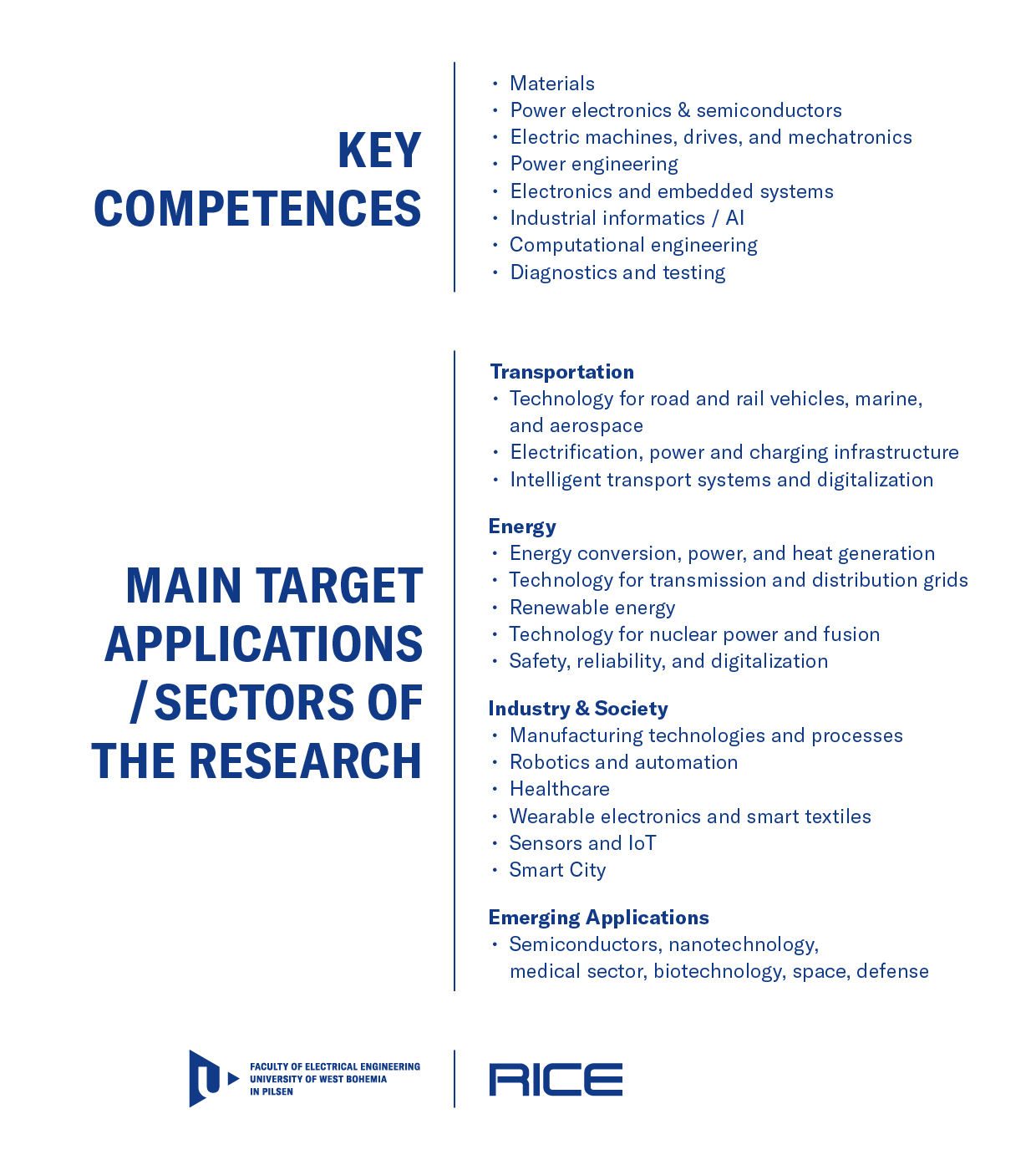
The faculty carries out its strategic research and development activities through the RICE research centre (Research and Innovation Centre for Electrical Engineering), where it concentrates its research and development capacities. The main key competencies in research and development and the main target applications of the results are illustrated in the following figure:
LINK TO OTHER STRATEGIC DOCUMENTS
The faculty’s strategic plan is aligned with the approved strategies of the EU, the Czech Republic, and the Pilsen Region. The following national documents are key for the further development of the faculty:
- National Research, Development and Innovation Policy of the Czech Republic 2021+
- Innovation Strategy of the Czech Republic 2019–2030
- Národní RIS3 strategie (National Research and Innovation Strategy for Smart Specialisation)
- Národní program orientovaného výzkumu, vývoje a inovací 2021+
- Hospodářská strategie České republiky 2020–2030
- Národní polovodičová strategie (National Semiconductor Strategy) (2024–2029)
- Vnitrostátní plán České republiky v oblasti energetiky a klimatu
- Státní energetická koncepce ČR
- Dopravní politika České republiky pro období 2021–2027 s výhledem do roku 2050
- Národní strategie umělé inteligence ČR 2030 (NAIS)
- Národní strategie pro kvantové technologie
- Strategie vzdělávací politiky České republiky do roku 2030+
- Strategický záměr MŠMT pro oblast vysokých škol na období od roku 2021
- Regionální inovační strategie Plzeňského kraje
- Dlouhodobý záměr vzdělávání a rozvoje vzdělávací soustavy Plzeňského kraje
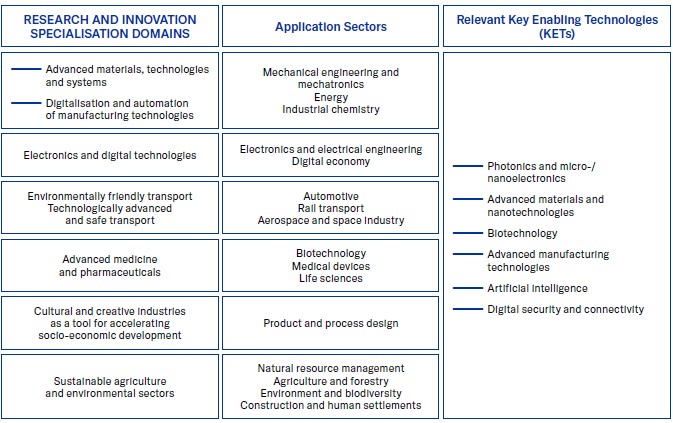
All major activities of the faculty are interconnected and based on the National Innovation Strategy RIS3. The following table provides the relevant application sectors for the faculty’s educational, creative, and research activities in relation to this document.
In accordance with the Regionální inovační strategie Plzeňského kraje, the faculty’s educational and creative activities are aligned with the following sectoral priorities (domains) of the Pilsen Region:
- Smart Mobility
- Modern Energy
- New Materials and Technologies
- Intelligent Manufacturing Systems
- Biomedicine and Medical Engineering
KEY INDICATORS
For the evaluation of progress in achieving the strategic objectives, key indicators have been define and are presented in the following table. The monitoring and assessment of these indicators will be carried out as part of the annual implementation plans of the Strategic plan.
KEY INDICATORS OF FEL